Why the Basketball Hoop Has a Backboard
Why does a basketball hoop have a backboard? See how it guides bank shots, shapes close-range choices and helps you read rebounds as play unfolds.
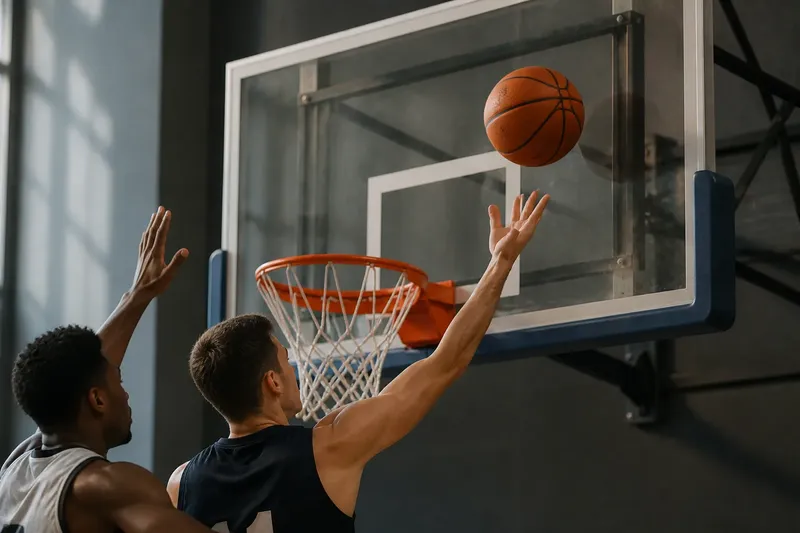
Why does a basketball hoop have a backboard? A basketball backboard gives players a surface to use for angled shots, and it also affects where missed balls rebound. Watch a player approach from the side and aim at the glass: the target is no longer only the rim.
The board shapes three parts of play near the basket: the path of a bank shot, the choices a shooter makes under pressure and the rebounds that follow a miss. Its presence turns the area around the hoop into more than a straight-on target.
The board defines the space behind the basket
A backboard sits behind the rim and forms a boundary at the rear of the scoring area. It also provides a solid surface that can redirect a ball towards the hoop. Those effects are easy to see in a close-range attempt, where a player may use the glass instead of sending the ball directly towards the rim.
The board’s exact historical origins are not needed to explain its role in the game today. Focus on what it does during play: it helps separate the target from the space behind it, gives shooters another aiming surface and sends some missed shots back into the court.
That last effect makes the board relevant to more than scoring. After a miss, the ball can rebound towards the lane, to one side of the rim or away from the immediate area. Players near the basket must track the ball’s route off both the rim and the board.
The glass gives angled shots another route
A bank shot uses the backboard to change the ball’s direction before it reaches the rim. The shooter aims above the hoop, then relies on the rebound from the glass to carry the ball towards the basket.
Think of the board like a wall beside a doorway: the direction of the bounce depends on the angle at which the ball reaches it. A shooter must judge the approach, the release and the contact point. The board redirects the ball; it does not correct every poor angle.
From the side, a direct attempt can have a narrow path past the rim. The glass offers another route, especially when a defender makes a straight line to the basket difficult. A shooter may also choose a direct shot when facing the hoop and seeing a clear opening.
Say a player drives towards the basket from the right, while a defender blocks the direct route. The player gathers near the side of the lane and sends the ball towards the upper-right part of the board, above the rim. The intended result is a rebound towards the hoop; if the contact point is too far to the side, the ball may travel away instead.
The contact point depends on the approach
A player approaching from the right often aims at the right portion of the board; a player coming from the left usually uses the opposite side. The useful point also depends on how close the player is and how sharply they approach the rim. There is no single spot that suits every bank shot.
The marked square on many backboards gives a visual reference, particularly for close attempts. It is not an exact target for every angle. A contact point that works on a near-side lay-up may send a wider attempt away from the hoop.
As a viewer, track the player’s path and then the ball’s contact with the glass. If the ball meets the board in a spot that matches the approach, the use of the backboard was likely deliberate. If the contact is awkward, the shot may have been forced or the aim may have been off.
The backboard shapes choices near the rim
A player attacking from the side can use the glass to keep the ball away from a defender and avoid a direct line through a crowded area. A defender, in turn, may challenge the release, occupy the path to the board or force the attacker towards a less favourable angle. The board adds options, but it does not decide which one is best.
At close range, a shooter can lift the ball against the glass rather than push it straight through the rim. This can suit a player moving quickly, reaching around a defender or finishing from a narrow angle. When the player has space and faces the hoop, a direct attempt may be simpler.
Backboards are commonly transparent, which lets spectators behind the basket see more of the action. The material does not change the basic task of redirecting the ball, but it affects how clearly viewers can follow the shot through the target area.
What should you watch for in a bank shot?
Why aim at the backboard instead of the rim?
From an angle, the glass can redirect the ball towards the hoop when a direct path is difficult. The shooter chooses a contact point to suit the approach and lets the rebound carry the ball towards the rim.
Does the marked square show the exact target?
It offers a visual guide, especially for close attempts, but the useful contact point changes with the player’s position. Follow the approach angle rather than assuming every shot should hit the same part of the square.
Why might a player choose a direct shot?
A direct attempt may suit a player facing the hoop with a clear path to the rim. The board is useful only when its rebound direction fits the shot.
Can the backboard affect a missed shot?
Yes. A ball that hits the board can rebound into the court, giving another player a chance to collect it. Watch where the ball travels after contact, not only whether it enters the hoop.
Follow the ball to understand the attempt
For each close shot, note whether the player comes from the left or right, where the ball meets the glass and where it travels next. This sequence helps distinguish a planned bank shot from a direct attempt that happens to hit the board.
Then watch the defence. If a defender crosses the attacker’s path, the player may change sides or release the ball higher. If another defender closes in, a pass may be a better option than a shot. These choices help explain why a shooter uses the board, avoids it or abandons the attempt.
Track the rebound too. A ball that strikes the board and misses the rim can travel in several directions, so players near the basket adjust to its path. The next time a player approaches from the side, notice where the ball meets the glass and whether that contact suits the route to the hoop.