The Offside Trap Is Not a Race to Stand Still
Understand the offside trap by tracking the passer, the defensive line and the runner, so you can read when a coordinated step catches an attack.
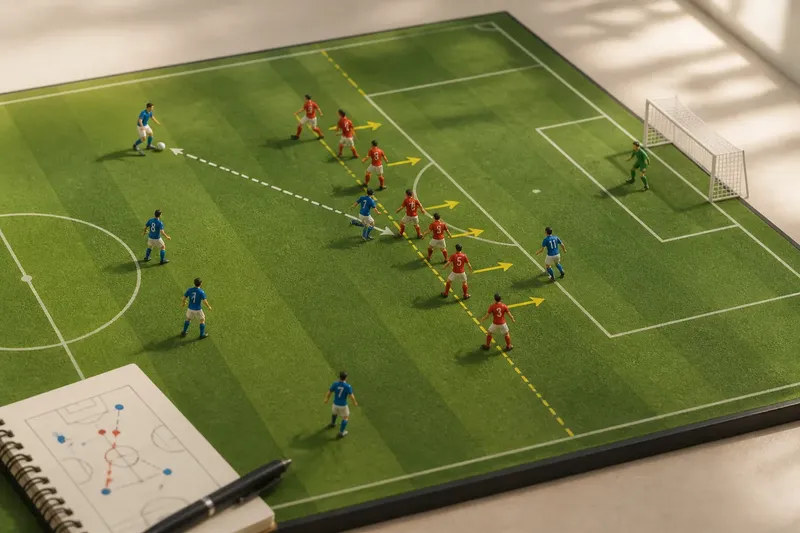
Why do defenders step towards halfway when a forward is preparing to run on to a pass? The offside trap is a coordinated attempt to leave an attacker in an offside position when a team-mate plays the ball. To read the offside trap, watch the instant of the pass, not just where the runner ends up.
The movement can look simple from the stands: several defenders advance together. Its difficulty lies in timing, spacing and communication. A line that moves too early may leave the attacker onside at the decisive moment; a defender who moves alone can open a route behind the group.
Judge the position when the ball is played
Offside is judged when an attacking team-mate plays or touches the ball, not when the receiver takes possession. At that moment, an attacker is in an offside position if they are in the opponents’ half and nearer to the opponents’ goal line than both the ball and the second-last opponent. Being in that position is not, by itself, an offence: the player must become involved in active play under the rules.
The goalkeeper is often the last opponent, but not always. The second-last opponent may be an outfield player. An attacker need not be ahead of every defender; being level with the second-last opponent is onside.
For a close decision, compare the attacker’s eligible body parts with the relevant opponents at the moment of the pass. Arms and hands do not count for players, including goalkeepers. The runner’s position when the pass arrives can look very different from the position that matters.
Think of a camera shutter: the play keeps moving, but the referee assesses one particular instant. The defenders’ line is useful context; the moment the ball is played is the frame to watch.
Track the passer and the whole line
A high defensive line is not automatically an offside trap. A team may hold a high position to keep its players compact and reduce space between defence and midfield. Look for a coordinated step as an opponent prepares a forward pass.
Follow this sequence during a match:
- When an opponent has the ball in midfield, note where the centre-backs and full-backs are positioned.
- As the passer takes a touch, looks up or shapes to play forward, check whether the defenders hold, advance together or retreat.
- Watch the instant the ball is played, then compare the attacker’s position with the ball and the second-last opponent.
- Follow the run and check whether the attacker becomes involved in active play.
- If a replay is available, pause at the pass, then watch the same passage at normal speed to see how the line moved.
Each part changes what you can conclude. If the defenders advance together as the passer prepares the ball, the movement may be a deliberate attempt to catch a runner. If they hold or retreat, the team may be responding to the passer’s space, the runner’s position or the cover available behind.
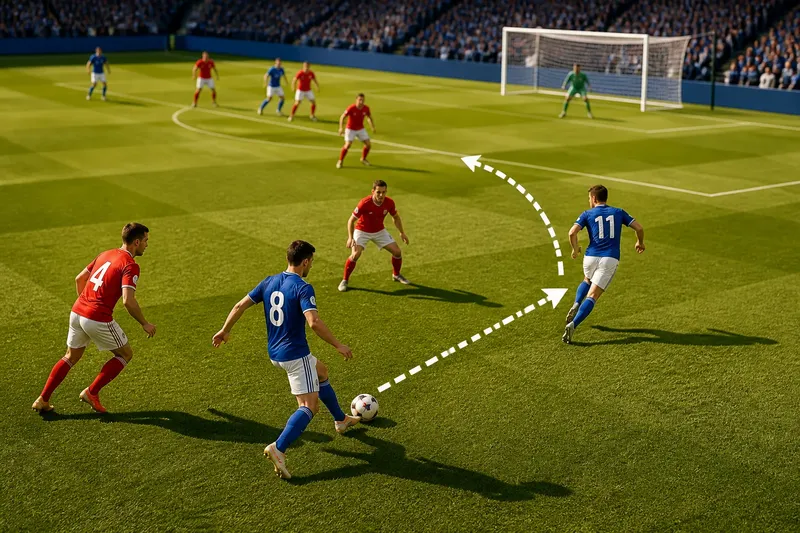
Say you are watching an invented match: the centre-backs are level while an opponent controls the ball in midfield, and a forward is poised to run. The passer turns towards goal and shapes to play forward; the defenders step together, and the full-back checks that they are not left behind. If the pass comes after the step and the forward then becomes involved from an offside position, the attack may be stopped. If the pass leaves the passer’s foot before the defenders move, the forward may instead be onside at that instant.
Look for a shared cue and connected spacing
The line often responds when a forward pass is about to be played. A controlling touch, a raised head or a body opening towards space can serve as a cue, but the right moment depends on the situation. Moving only after the ball travels is usually a late reaction.
Centre-backs need to keep their spacing as they step, and full-backs matter just as much. One defender staying deeper can keep an attacker onside even when the central defenders advance. Judge the line as a group, rather than using one player as a fixed marker.
Communication may be a call, a glance across the line or players reading one another’s movement. A defender may check over a shoulder for a runner, confirm the line and step as the passer commits. The midfield also matters: pressure can make a clean forward pass harder, while an unchallenged passer may have time to play into the space behind.
Balance the space gained against the space left behind
Advancing can reduce the room in front of the defence and make it harder for attackers to receive between the lines. It also leaves space behind for a pass to exploit. The team is trading protection in one area for greater exposure in another.
A team may hold a high line when it can pressure the passer, keep defenders connected and cover a direct ball. If the passer has time and a clear view, defenders may drop instead. Their choice depends on the ball, the attackers’ positions and the available cover.
The trap can fail for different reasons. The pass may be released before the line moves; one defender may be delayed; or the attacker may time a run from an onside position. An attacker in an offside position may also leave the ball alone without interfering with an opponent or gaining an advantage. The defenders’ movement alone does not tell you whether an offence occurred.
What should you watch as the pass develops?
When is offside judged?
Officials assess the attacker’s position when a team-mate plays or touches the ball, not when the receiver gets it. A run that ends beyond a defender may have started from an onside position at the decisive moment.
Does an offside position always stop play?
No. The player must become involved in active play, such as playing the ball or interfering with an opponent. Someone can be in an offside position without committing an offence.
Can an attacker be level with the second-last opponent?
Yes. Being level with the second-last opponent is onside, provided the attacker is not nearer to the goal line than the ball at the moment it is played.
Why might play continue after an assistant referee raises a flag?
In some competitions, an assistant referee may delay a flag while an attack develops and the decision is close. The referee may then stop play or allow the sequence to continue under that competition’s procedures.
Assess the sequence before blaming a defender
If a forward escapes, check the timing before deciding that the line failed. Did the pass leave the passer’s foot before the defenders stepped? Did one player hold deeper? Was the runner onside when the ball was played, despite appearing ahead by the time it arrived? Each possibility points to a different moment in the move.
If the attack is stopped, look for what helped the line move together. Did pressure limit the passer? Did the defenders keep their spacing? Did the attacker start the run too soon? The answer can involve several players, even if a replay focuses on the forward and one centre-back.
To understand an offside trap, follow the passer’s preparation, the entire defensive line and the attacker’s position at the release. That sequence tells you more than simply noticing who stood furthest up the pitch.